








Key takeaways
GHK-Cu (glycine-histidine-lysine with copper) is a three-amino-acid peptide bound to copper and used in topical cosmetics.
Much of the relevant research is laboratory or early-stage work, which doesn't establish a guaranteed result from a serum.
Product expectations belong with scalp care and the appearance of fuller, thicker-looking hair.
Before-and-after photos can be swayed by lighting, styling, camera angle, and hair condition.
Follow the current label, introduce products one at a time, and stop if irritation develops.
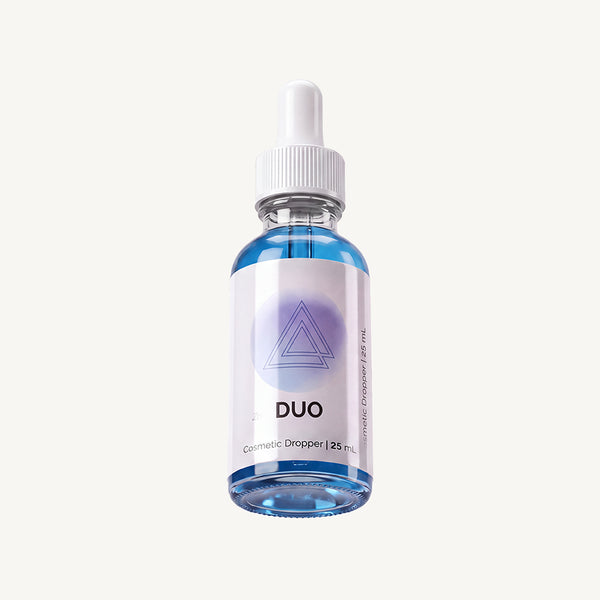
Copper peptides for hair are small amino acid chains bound to copper, used in topical cosmetic formulas and studied in skin and scalp research. GHK-Cu is the best-known example, and InfiniWell’s DUO GHK-Cu and zinc thymulin serum brings it to the scalp as a cosmetic step for the appearance of fuller, thicker-looking hair. Research interest in GHK-Cu is substantial, though the evidence is still early and results vary from person to person.
If you're considering a scalp serum, the practical questions are what the formula contains, what evidence supports its cosmetic claims, and how it fits a routine you can keep up. Ingredient research isn't proof that DUO produces a specific change in your hair, so expectations stay with scalp care and how your hair looks.
This guide is written for healthy adults curious about copper peptides for hair: what they are, what early research suggests, how to read before-and-after photos, and how to choose and use a GHK-Cu serum.
What are copper peptides?
Copper peptides are peptide molecules bound to copper. Peptides are short chains of amino acids, and their sequence shapes how each one behaves, so a finding about one peptide shouldn't automatically be applied to every other peptide containing copper.
GHK stands for glycine-histidine-lysine, a sequence of three amino acids. The “Cu” in GHK-Cu identifies copper, which is part of the complex rather than a fourth amino acid.
The glycyl-histidyl-lysine chemical record identifies its amino acid sequence and its tendency to form a complex with copper. That chemistry explains the name, but the name alone doesn't establish a cosmetic outcome.
Why GHK-Cu appears in scalp-care discussions
GHK-Cu has been studied in biological settings relevant to skin and hair, which has encouraged interest in topical formulations. An ingredient can be scientifically interesting well before there's strong evidence for a particular consumer outcome, though.
Most copper peptide products for hair are topical serums applied to the scalp, while skin products also come as creams. A GHK-Cu serum also contains more than the named peptide: its vehicle, other ingredients, packaging, and directions all shape how it's used. A study of GHK-Cu in one experimental preparation isn't automatically a study of a different finished formula.
For a broader ingredient introduction, read our guide to what GHK-Cu is. This article sticks to the hair care conversation and realistic cosmetic expectations.
Do copper peptides work for hair?
Early research supports continued investigation, but it doesn't justify a blanket promise of visible change. Copper peptide hair products are best discussed as topical cosmetic care, with claims tied to the actual formula and the scientific evidence available.
The word “work” can hide several different questions. These are the kinds of outcomes researchers and brands measure, and each answers something different:
Laboratory outcomes: A cell experiment might examine a single cellular process or marker.
Perceived appearance: A cosmetic study might ask whether participants think their hair looks fuller.
Standardized assessment: A trained grader or imaging method might measure something else entirely.
Those outcomes shouldn't be blended together. An observation in cells isn't the same as a demonstrated change in a person’s hair, and the look of fuller hair is a different outcome from a measurement of hair density.
What early GHK-Cu research on hair follicles can tell us
Researchers have explored GHK-Cu in experimental systems related to skin and to the biology of hair follicles, including lab work on follicle function. That work helps identify mechanisms and questions for further study, and it should be described as research with the model and formulation kept visible.
One specialized GHK-Cu microemulsion study, for example, tested an experimental delivery system in human skin cells, pig skin, and mice. It reported roughly three times more local delivery of copper peptides than the comparison and found the peptides kept their antioxidant activity in the lab.
It wasn't a clinical trial of InfiniWell DUO, and findings from that formulation shouldn't be presented as outcomes for a retail scalp serum. A credible explanation keeps those missing steps visible rather than filling them with a promise.
What the research doesn't establish
Current research doesn't show that every copper peptide serum produces the same effect, and it doesn't provide a universal timeline for visible results. It also doesn't show that using more of a product leads to a better cosmetic outcome.
When evaluating a claim, look for research on the complete formula, using its intended topical application and measuring the specific appearance outcome being described. If those details are missing, the claim should stay limited.
Scalp health and the appearance of fuller hair
How hair looks depends on several everyday factors. The main ones are below:
Texture and styling: Cut, product choice, and how hair is dried change apparent volume.
Cleanliness and residue: Buildup can weigh strands down or make them clump.
Lighting: Overhead light shows more scalp than soft, side light.
Life stage and lifestyle: Age, sleep, stress, and the nutrients in your diet all play into how hair looks over time, for women and men alike.
Scalp comfort is another part of the experience, and it's a practical reason to build a routine that's simple and easy on your skin. A cosmetic serum can have a place in that routine as one part of scalp health and healthy hair habits, while expectations for DUO stay with topical scalp care and the look of fuller, thicker hair.
That sets a fair standard for evaluation. You can decide whether a product fits comfortably into your routine and whether you like how your hair looks, without reading every visual difference as evidence of a biological change.
The hair cycle isn't a product countdown
Hair naturally moves through phases over time, and different hairs are at different stages. That's why hair appearance shifts gradually and why a photo taken on a particular day is only a snapshot.
The hair cycle doesn't set a date by which a serum should produce a result. A claim that everyone will see a particular change after a fixed number of weeks needs direct evidence, and the existence of a hair cycle doesn't supply that evidence on its own.
Skin research isn't automatically hair research
GHK-Cu also shows up in research on skin appearance, where interest centers on qualities such as skin firmness, elasticity, and a smooth texture. Collagen, a structural protein in skin, comes up often in that conversation.
A finding about skin shouldn't be converted into a hair claim simply because both involve a topical ingredient. The tissue, formula, and measured outcome all count, so if a study discusses a skin marker, it should be described as that marker.
How to read GHK-Cu before-and-after images
Before-and-after images can make a product feel easier to understand, but they aren't controlled evidence by themselves. Lighting and presentation can create large differences even when the underlying hair hasn't changed the way a viewer assumes.
A fair comparison needs consistent conditions. The table below lists the photo details that most often change the impression, and why:
Detail |
Why it can change the impression |
Lighting direction |
Strong overhead light can make the scalp more visible |
Hair part |
A different part can expose a different area of scalp |
Wet or dry hair |
Wet strands often group together differently |
Styling and product residue |
Volume, texture, and shine can affect apparent fullness |
Camera angle and distance |
Small changes can alter how much scalp is visible |
Hair length or color |
Both can change contrast and the overall impression |
What a testimonial can tell you
A testimonial describes someone’s experience. It can be useful for questions about texture, packaging, or ease of use, but it doesn't establish that the product caused every reported change.
People often change several parts of their routine at once, and time, styling, other products, and ordinary variation can all influence the result. A testimonial isn't a substitute for research on the finished formula.
If you keep your own photo record
Use the same room, lighting, camera position, and hair condition, and choose a consistent part. A simple, repeatable setup is more informative than a dramatic photo, and comparing a carefully styled day with a very different starting image tells you little.
You don't need to take pictures every day, since frequent checking can make normal variation feel bigger than it is. A personal record can help you describe your experience, but it can't prove that a serum caused a particular change.
What to look for in a GHK-Cu serum
Start with ingredient identity and intended use. The label should make clear that the product is a topical cosmetic and give directions that are easy to follow, and the full ingredient list deserves as much attention as the copper peptide highlighted on the front.
Ask whether the product’s claims are about appearance and whether the supporting evidence matches them. A long list of research references isn't automatically stronger if the references concern different molecules, routes, or formulas. These questions help you compare options:
Identity: Does the formula name the copper peptide it contains?
Directions: Are they specific about the area and method of topical application?
Transparency: Can you review all ingredients before buying?
Evidence: Are the cosmetic claims supported by relevant evidence rather than unrelated mechanisms?
Practicality: Does the packaging make daily use and storage easy?
Our guide to how to choose a scalp serum offers a broader comparison framework. Keep any product decision grounded in the current label and realistic appearance expectations.
Concentration isn't a complete ranking system
A stronger-sounding percentage doesn't automatically make a serum better. Concentration is only one aspect of a formula, and a fair comparison also accounts for stability, the vehicle, other ingredients, and how the product is meant to be used.
If a concentration isn't clearly disclosed, don't infer it from the color of the liquid or the name on the bottle. Appearance isn't a reliable laboratory measurement of ingredient content.
Quality testing and cosmetic evidence answer different questions
A quality test may address ingredient identity, purity, or stability, while a cosmetic study addresses a measured or reported appearance outcome. One doesn't replace the other.
A transparent brand makes the scope of its evidence easy to understand. “Tested” is more useful when it comes with what was tested, which formula was involved, and what the result supports.
Where DUO fits in a scalp-care routine
DUO combines GHK-Cu and zinc thymulin in a topical cosmetic serum for scalp care and the appearance of fuller, thicker-looking hair, with results varying between people.
Two ingredient names don't establish that the combination reproduces the findings of separate studies, so research on GHK-Cu alone or zinc thymulin alone stays separate from what we say about DUO as a complete product. For background on the second ingredient, our article on what research shows about zinc thymulin gives useful context for the label.
Keep the application routine straightforward
Follow the current label for where, how often, and how much to apply. More frequent application isn't a shortcut to a better result, and instructions from an unrelated serum don't carry over just because its ingredient list looks similar.
Use clean hands, handle the applicator as directed, and keep the bottle closed between uses. These ordinary habits keep the routine consistent without making it complicated.
Patch testing, irritation, and layering
Any cosmetic formula can cause irritation for some people, and reactions can include mild redness, itching, or discomfort where the product was applied. A patch test can be a cautious first step, but it can't guarantee that a product will remain suitable with repeated use.
Introduce one new product at a time when you can, which makes it easier to spot what changed if your scalp reacts. Irritation isn't a sign that a serum is working. If it develops, stop using the product and talk to a qualified professional if it persists.
Can copper peptides be layered with other products?
Compatibility depends on the complete formulas, not just ingredient names, and there's no universal rule about combining every copper peptide serum with every other active ingredient.
Check the manufacturer’s directions, especially when using strong cosmetic actives, and don't mix products together in their bottles. If the instructions are unclear, ask the manufacturer or a qualified professional before building a more complex routine.
Pregnancy and breastfeeding
A topical cosmetic isn't automatically appropriate during pregnancy or breastfeeding just because it's applied to the scalp. Review the full formula and talk it through with your healthcare professional, separate from how appealing the packaging, reviews, or peptide name may be.
Decide what would make the routine worthwhile
Before adding a serum, identify what you want from the cosmetic experience. You may value an easy application, a comfortable scalp routine, or how your hair looks with your usual styling, which are more concrete goals than an unspecified promise.
If you replace shampoo, styling products, and serum all at once, it's hard to know which change affects texture or comfort. Introducing changes separately keeps the routine easy to understand. When you're ready to build that routine, explore our hair and scalp collection.
Copper peptides for hair: FAQs
-
SOURCES
Products mentioned in this article
You May Also Like
View All Articles

Best Akkermansia Supplement: What to Check Before Choosing
Choosing an Akkermansia supplement starts with the label: the organism, whether it's live or pasteurized, how the count is measured, and what else is in the formula. Here's how to check each one, from count units to storage, testing documentation, and price per serving.

What Is a Tripeptide? Understanding KPV and GHK-Cu
A tripeptide is a small molecule made of three amino acids, but the name alone says little about what it does. This guide uses glutathione, KPV, and GHK-Cu to show how sequence, chemical form, and evidence set each one apart, and how to read a tripeptide claim on a label.