








Key takeaways
A tripeptide contains three amino acids linked by two peptide bonds.
Sequence sets identity: changing an amino acid or its position changes the molecule.
Glutathione, KPV (lysine-proline-valine), and GHK (glycine-histidine-lysine) show how different tripeptides can be.
GHK-Cu is GHK bound to copper and is discussed here only as a topical cosmetic ingredient.
Small size alone doesn't establish absorption, safety, or a benefit from a finished product.
A tripeptide is a small molecule made of three amino acids joined by two peptide bonds. You'll see the term on labels as different as BPC + KPV capsules and copper peptide serums, because the word describes the length of the chain, not a single ingredient or a shared benefit. Which amino acids are present, their order, and the molecule’s chemical form decide how a particular tripeptide behaves.
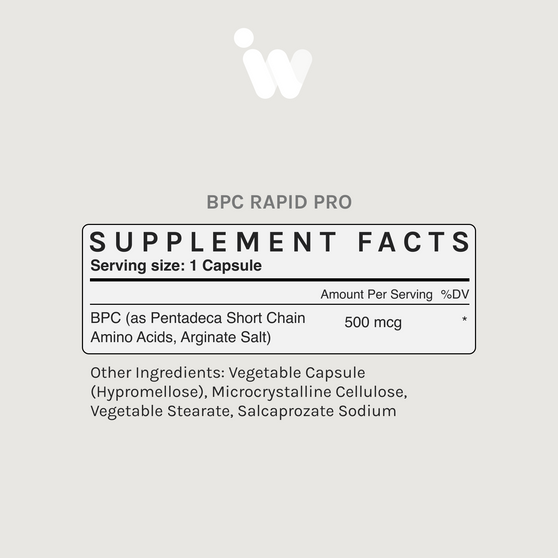
Glutathione, KPV, and GHK are familiar examples. GHK can also bind copper to form GHK-Cu, a copper peptide used in topical cosmetic products, and while these names share a chemistry conversation, they aren't interchangeable. InfiniWell BPC + KPV includes KPV within an oral formula, while our DUO hair serum pairs GHK-Cu with zinc thymulin in a topical cosmetic.
This guide is written for curious readers who've spotted “tripeptide” on a supplement or skincare label and want to know what it means, how tripeptides work, and how KPV and GHK-Cu each fit.
Amino acids, peptides, and proteins
Amino acids are the building blocks used to make peptides and proteins. When amino acids connect through peptide bonds, they form a chain. Short chains are generally called peptides, while longer, folded chains are described as proteins.
The terminology gets more specific when the chain is very short. A dipeptide has two amino acids, a tripeptide has three, and a tetrapeptide has four, so a tripeptide sits at an intermediate size between dipeptides and larger polypeptides. These names tell you about chain length, the same way a word’s letter count tells you its length without telling you its meaning.
There's no single benefit shared by all three-amino-acid chains. Some take part in normal cellular chemistry, while others are studied for particular interactions. The table below shows what each term tells you and what it leaves open.
Term |
What it tells you |
What it doesn't establish |
Amino acid |
An individual building block |
The properties of a longer chain made from it |
Dipeptide |
A chain containing two amino acids |
A particular wellness or cosmetic outcome |
Tripeptide |
A chain containing three amino acids |
That all such molecules behave alike |
Copper peptide |
A peptide associated with copper |
That every copper peptide product has the same evidence |
Peptide formula |
A finished product containing one or more peptides |
That each ingredient has been tested in that combination |
Why amino acid sequence sets a tripeptide's role
A tripeptide’s sequence is the order of its amino acids, and scientists use one-letter or three-letter codes to describe it. GHK, for example, stands for glycine, histidine, and lysine in that order.
Those letters aren't a marketing acronym chosen at random. They identify chemical building blocks, and the glycyl-histidyl-lysine chemical record spells out the same sequence in full chemical naming.
Different amino acids have different chemical properties. Their side groups influence features such as charge and how they interact with other molecules, so changing the sequence can change how a peptide behaves even when the total number of amino acids stays the same.
Three amino acids make one distinct molecule
A linked tripeptide is its own molecule, with bonds and an arrangement that shape how it interacts with its surroundings. That's different from a loose mixture of the same three amino acids.
The distinction is worth keeping in mind when you read a label or a research paper. A study of an intact tripeptide isn't automatically a study of the individual amino acids taken separately, and a finding about one sequence can't be transferred to another just because both contain three units.
Chemical form adds another distinction
A peptide may appear in a particular salt form or as part of a complex. GHK-Cu is a helpful example, because the copper is part of the name and part of the chemistry being discussed.
The “Cu” refers to copper, not a fourth amino acid, and GHK remains the three-amino-acid peptide component. That's why a copper peptide can still be described in the context of tripeptides.
How do tripeptides work?
There's no single mechanism that applies to every tripeptide. A molecule’s role depends on its identity, its environment, and whether it reaches the place where the relevant interaction can happen.
Some tripeptides take part in normal cellular reactions, while others act as signaling molecules that cells respond to. A topical cosmetic formulation adds another layer of questions, including stability and how the ingredient behaves in the complete formula.
The useful answer is specific: identify the tripeptide, identify the proposed role, and identify the evidence behind that role. “Peptides communicate with cells” is too broad to establish what a particular product does.
Does small size mean better absorption?
Small size is often linked with high bioavailability, but size is only one factor in how molecules move through biological barriers. Charge, chemical stability, the route of use, and the surrounding formulation all play a part, too.
For an oral product, digestion and transport are relevant. For topical application, the skin barrier and the formula are relevant, and evidence about one route shouldn't be used to make claims about another.
A statement such as “three amino acids, so it absorbs completely” skips those questions. Reliable claims need measurements for the ingredient and formulation being discussed, rather than an assumption based only on chain length.
Familiar tripeptide examples
Several well-known molecules show how much range sits inside this one category. Here are three of the most familiar ones, each with a very different job:
Glutathione: A tripeptide the body makes from glutamate, cysteine, and glycine, best known as an antioxidant.
Thyrotropin-releasing hormone (TRH): A signaling tripeptide made in the hypothalamus, a region of the brain, that prompts the release of other hormones.
GHK: A tripeptide found in human plasma that readily binds copper to form GHK-Cu.
KPV is another example, covered in its own section below. None of these share a use or an evidence base simply because they share a chain length.
Glutathione: The body's own antioxidant
Glutathione contains cysteine, glutamic acid, and glycine, and its thiol group is what makes it an effective antioxidant in cellular redox chemistry. It's a clear example of how a short peptide can have a specific biological role.
Its structure also shows that chemistry has details beyond the three-amino-acid count. The glutamic acid attaches through its side chain rather than the usual backbone linkage found in many peptide chains, yet the name “tripeptide” still applies because it describes the linked amino acid units.
That role in the body is a separate question from the effect of taking a supplement containing glutathione. It also doesn't make GHK or KPV antioxidants or give them the same uses, which is why a product that mentions a tripeptide without naming it leaves the description incomplete.
GHK-Cu peptide: The copper peptide example
GHK is the sequence glycine-histidine-lysine. It's found in human plasma, and it readily forms a complex with copper ions. That copper peptide complex is called GHK-Cu, and it has attracted interest in cosmetic research involving skin and scalp care.
For a consumer discussion, the relevant use is topical cosmetic care. Claims should stay with the appearance of skin and hair, and with the evidence available for the particular product. Laboratory findings don't establish a guaranteed visible result from a serum.
Our dedicated guide to GHK-Cu provides more ingredient background. Here, it serves as an example of how a tripeptide’s sequence and its interaction with a metal set it apart from other peptides.
GHK-Cu in skincare and topical use
As a topical cosmetic ingredient, GHK-Cu is commonly found in serums and creams applied to the face or scalp. The look of firm, smooth skin depends partly on structural proteins such as collagen and elastin. Cosmetic interest in copper peptides centers on appearance qualities like elasticity, texture, and a smoother look.
Follow the product label directions for how much to use and how often.
What early research can tell us
Researchers can study a molecule in cells, in a specialized formulation, or in other experimental settings. Those studies help identify questions worth exploring, but they don't all provide the same kind of evidence.
Research involving a specially designed topical delivery system can't automatically be used to describe a different cosmetic serum. The complete formulation affects how an ingredient behaves, and the tested outcome has to match the claim being made.
Where GHK-Cu fits in DUO
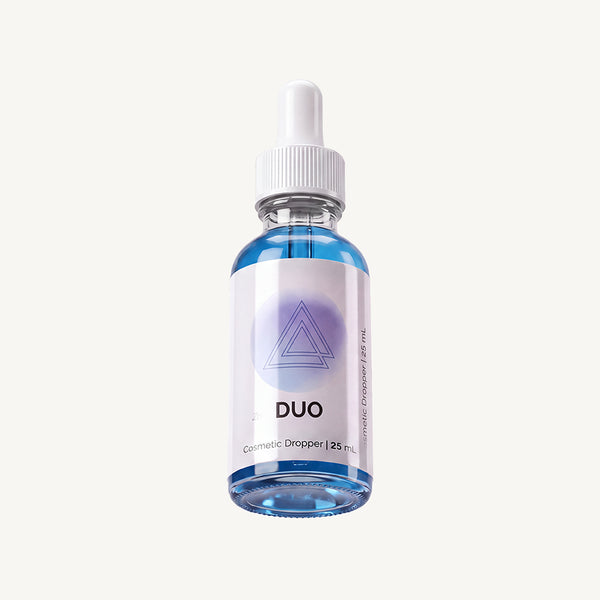
DUO combines GHK-Cu and zinc thymulin in a topical cosmetic serum for scalp care and the appearance of fuller, thicker-looking hair. Applied to the scalp around the hair follicles, it's a cosmetic step in a hair-care routine, and an ingredient’s research history isn't a promise of any specific change in your hair.
Follow the current directions and review the full ingredient list. If you're comparing serums, our guide to choosing a scalp serum can help organize questions about formulation and routine.
KPV: Another three-amino-acid sequence
KPV stands for lysine-proline-valine. The abbreviation identifies the sequence: K is lysine, P is proline, and V is valine. It's a different tripeptide from GHK, with its own research questions.
That difference outweighs the shared chain length. Evidence about GHK-Cu can't establish an effect for KPV, and evidence about KPV doesn't establish an effect for a copper peptide serum.
Our KPV peptide guide covers the ingredient in more detail. In this parent explainer, the useful point is recognizing KPV as a specific sequence rather than treating “tripeptide” as a product benefit.
Where BPC + KPV fits
InfiniWell BPC + KPV is a combination product, so read its label as a complete formula. The KPV in the name is one ingredient identity, not proof that the finished product reproduces a finding from research on individual peptides.
The current product page and label give the format, ingredient details, and suggested use. Keep oral and topical products in their own lanes: a cosmetic serum's directions don't transfer to a capsule, or the other way around, just because both contain peptides.
How to evaluate a tripeptide claim
Start with the exact name. “Peptide technology” or “tripeptide complex” may sound specific, but those phrases alone don't tell you which molecule was studied or whether the formula matches the research literature.
Then look at the research setting. Was the study done in cells, in an experimental model, or in people using the finished product? Did it measure a chemical signal, an appearance outcome, or something else? These questions keep the comparison clear:
Sequence: Which peptide sequence is present?
Form: Is it bound to copper or supplied in another specified form?
Route: Is the intended use oral or topical?
Match: Does the study use the same ingredient and formulation?
Outcome: Does the study directly measure the outcome described in the claim?
A clear answer to one question doesn't answer the others. Confirming ingredient identity is useful, but it's different from demonstrating a benefit.
Testing and quality documentation
Quality testing may assess identity, content, purity, or contaminants. The scope depends on the test, so read a certificate for what it measures.
A purity result doesn't establish a visible cosmetic outcome, and a stability result doesn't establish that a supplement suits every person. Good documentation answers a specific question rather than serving as a universal guarantee.
Compare the whole formula
Other ingredients can affect texture, storage, comfort, and how a product fits a routine, so a serum and a capsule can't be ranked fairly from the peptide name alone.
Consider whether the directions are clear and practical, whether the packaging suits the product, and whether the manufacturer provides current information. A longer ingredient list or a stronger-sounding concentration isn't automatically better.
Keep category names separate from product directions
A chemistry definition can help you understand an ingredient list, but it can't supply directions for a finished product. Two products containing tripeptides may have entirely different purposes and handling requirements, so use each label for its own format and application.
If you're exploring products, you can browse BPC Precision Aminos for oral formulas, or our hair and scalp collection for topical cosmetic care.
Tripeptide: FAQs
-
SOURCES

You May Also Like
View All Articles

What Is Alpha-MSH? The Hormone KPV Comes From
Alpha-MSH is a small signaling hormone your body makes from a larger precursor, and the KPV peptide is just the last three amino acids of it. This guide explains what alpha-MSH is, where it comes from, what it does, and how KPV fits in, without blurring the line between the hormone and the fragment.

Hair Density vs. Thickness: What's the Difference?
Hair density is how many strands you have, and hair thickness is how wide each strand is. They sound similar, but they're two different things, and mixing them up leads to the wrong styling and product choices. Here's how to tell them apart and work with what you've got.