








Key takeaways
-
"Oral peptides" is too broad a label for one yes-or-no answer. Whether a product is absorbed depends on the molecule, the formulation, and where it needs to act.
-
Digestive enzymes break most peptides into amino acids, so only some survive the gut and reach the bloodstream.
-
Formulation design, such as protective capsules and absorption enhancers, can help some peptides survive digestion, but each formula needs its own evidence.
-
Hydrolyzed collagen peptides are the most studied oral peptides. Many peptides sold online still lack strong human trials.
-
Read the Supplement Facts label and a batch Certificate of Analysis before you buy, and talk to a qualified healthcare professional first.
Do oral peptides work? Some do and many do not. The answer depends on the specific peptide, how the product is formulated, and whether it is meant to act inside the gut or reach the rest of the body. This guide is written for healthy adults weighing an oral peptide capsule who want to separate what research shows from marketing before spending on their health. If you are comparing options like BPC + KPV, the same three questions apply: what is the molecule, how is it delivered, and what has actually been measured?
The growing use of peptide supplements has made the category feel bigger than the evidence behind it, especially for everyday health. So instead of a blanket verdict, it helps to follow a peptide from the capsule to the bloodstream and see where most of them fall short.
What is a peptide?
A peptide is a short chain of amino acids, the same building blocks that make up proteins. Peptides act as biological messengers: they bind receptors and signal cells to act on a specific target. A dipeptide has two amino acids and a tripeptide has three, and these short chains behave very differently from long proteins.
Amino acids are also essential nutrients the body uses in everyday metabolism, which is part of why peptides are so hard to keep intact through the gut. Different peptides bind different receptors, so a shared category name does not make two of them interchangeable. KPV, for example, is a tripeptide made of lysine, proline, and valine.
You can read more about what KPV is and its relationship to alpha-MSH, but that background is biology, not evidence that every peptide produces the same result.
What happens after you swallow a peptide?
An oral peptide faces a demanding trip before it can do anything. The gastrointestinal (GI) tract is designed to break proteins and peptides down into amino acids, which limits how much intact peptide gets through, as Harvard Health notes. Digestive enzymes and stomach acid drive much of this degradation as part of normal metabolism.
Surviving that environment is only the first step. To reach the rest of the body, a peptide must also cross the tight junctions of the intestinal barrier and enter circulation before it can reach any target tissue. Some bioactive peptide fragments can survive digestion and reach the bloodstream, but most are taken apart along the way.
It helps to treat oral delivery as a series of separate questions rather than one event:
Stage |
What researchers ask |
Stability |
Does the peptide stay intact through stomach acid and enzymes? |
Release |
Where and when does the capsule release it? |
Absorption |
Does it cross the gut barrier into the blood? |
Effect |
Does a measured outcome change against a comparison group? |
Passing one stage does not prove the next. A capsule can protect its contents in a lab test without showing that a peptide reaches circulation, and a detectable blood level does not by itself prove a meaningful result.
Why most oral peptides are hard to absorb
Most oral peptides have low and unreliable absorption, and standard capsules tend to deliver minimal systemic exposure, according to a managed-care review of oral peptides. In plain terms, a lot of what you swallow never reaches the blood intact.
Bioavailability, the share of a serving that actually reaches circulation, varies widely from one peptide to the next. Low bioavailability is the norm here, not the exception. Efficacy depends heavily on the type of peptide and its formulation, so a label that promises something is "easily absorbed" is worth a closer look rather than a leap of faith.
How formulation changes the odds
The performance of an oral peptide depends largely on how the molecule is protected from digestion. Formulation design, such as protective capsules, carrier ingredients, and absorption enhancers, can help some peptides survive the gut and be absorbed, but each formula needs its own evidence. Advanced delivery systems include liposomes and nanoparticles.
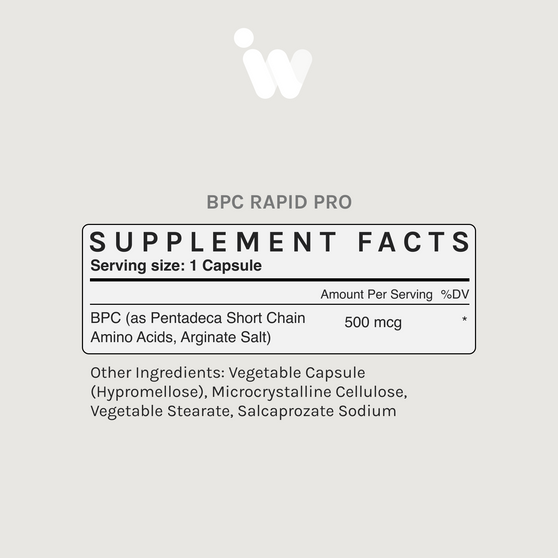
Researchers also use absorption enhancers, such as salcaprozate sodium (SNAC), to help some peptides cross the gut lining, a strategy covered in peptide delivery research. BPC + KPV lists salcaprozate sodium among its other ingredients on the label. That tells you what is in the capsule, not that it raises how much BPC or KPV is absorbed. To see how packaging and route shape a peptide, read how peptide formats differ.
Oral vs. injected peptides: How the routes compare
An oral capsule and an injection answer different delivery questions, so research on one route does not carry over to the other. Swallowed peptides usually need larger amounts than injected ones to reach the same blood level because the gut breaks down so much of the serving first.
Feature |
Oral route |
Injected route |
First stop |
Meets stomach acid and digestive enzymes |
Skips the gut entirely |
Amount needed |
Often larger to reach the same blood level |
Usually smaller |
Convenience |
Needle-free and simple to take |
Requires an injection |
Evidence needed |
Studies of the oral formulation |
Studies of that injected formulation |
This table compares research routes only. It is not instructions for using either one. An injection study does not validate a capsule, and convenience alone does not settle whether a product works.
What the research shows for KPV
KPV is a useful example of reading evidence by type, because its research sits mostly in cells and animals rather than in people. PepT1 is a transporter in the intestinal lining that can transport small di- and tripeptides generated during digestion, and whether it moves a given peptide toward its target can be tested in the lab.
In a 2008 lab study, researchers found that KPV can enter intestinal cells through the PepT1 transporter, and they also tested orally delivered KPV in mice. This has not been tested in people. Cell and animal findings are mechanistic signals, not human proof.
There is no large randomized clinical trial with a placebo group showing that an oral KPV product does the same thing in people, and a finding for the ingredient alone is not a result for a finished blend. For the capsule side of this, see how KPV capsules work.
Collagen peptides: The most studied oral peptide
Hydrolyzed collagen peptides are the most thoroughly researched oral peptides available, which is why they come up in almost every peptide and health conversation. They supply amino acids, but they are not a complete protein on their own.
Collagen peptides have been studied for skin hydration and joint comfort in adults. Those findings are specific to collagen and do not transfer to other peptides, so collagen research cannot stand in as evidence for a different molecule or blend.
How to read an oral peptide label
A clear label is the fastest way to judge an oral peptide. Start with the exact ingredient and serving, then check that any claim matches what was measured for that preparation. A few habits protect you:
-
Match the molecule: Confirm the product uses the same peptide a study looked at, not just the same category name.
-
Check the evidence type: Ask whether the work was done in cells, animals, or people, and whether it was confirmed in clinical trials of the finished formula.
-
Look for a Certificate of Analysis: A batch Certificate of Analysis documents tested attributes for the lot you are buying.
-
Read the manufacturing standard: Production under current Good Manufacturing Practices (cGMP) supports consistent quality. It does not show that a product works.
Many peptides marketed online still lack strong human trials and long-term safety data, and broad healthy-aging claims for many peptide products are not well supported by evidence, as clinicians at UCHealth point out. Supplements are not reviewed the way medicines are, so the Supplement Facts label, the suggested use, and batch testing are what you have to go on. A product with no full label and no batch testing gives a buyer very little to judge.
Where BPC + KPV fits
BPC + KPV lists BPC as Pentadeca Short Chain Aminos and KPV as Tri Short Chain Amino Acids in oral capsules, with salcaprozate sodium among the other ingredients. Those label identities are a starting point for reviewing the product, not evidence of absorption or a human benefit from the finished combination.
A study of KPV alone would not automatically establish the effect of the BPC component or of the blend, and the reverse is true as well. If the serving information on the label is unclear, ask the maker to confirm it rather than borrowing a schedule from an unrelated source.
The bottom line on oral peptides
So, do oral peptides work? Some can, depending on the exact peptide and how it is formulated, while many deliver little once digestion is done with them. The useful move is not to accept or dismiss the whole category, but to keep each claim attached to its evidence: the molecule, the route, the type of study, and the outcome that was measured.
If you are reviewing BPC + KPV, use the complete current label, weigh its safety profile and tolerability like any supplement, and talk with a qualified healthcare professional about whether it fits your health and wellness routine.
Do oral peptides work: FAQs
-
SOURCES
Products mentioned in this article

You May Also Like
View All Articles

What Is Alpha-MSH? The Hormone KPV Comes From
Alpha-MSH is a small signaling hormone your body makes from a larger precursor, and the KPV peptide is just the last three amino acids of it. This guide explains what alpha-MSH is, where it comes from, what it does, and how KPV fits in, without blurring the line between the hormone and the fragment.

Probiotics After Antibiotics: How to Support Your Gut Health
Probiotics after antibiotics are worth thinking about, but the evidence is more specific than most headlines suggest. Here's a look at what research shows, the foods that support a healthy gut, and how to read a probiotic label before you buy.