






























Key takeaways
-
NAD+ is an essential coenzyme your cells need for energy production, activating key cellular health proteins, and hundreds of critical cellular processes, but its levels may decline with age.
-
NMN is a direct precursor to NAD+ that your body converts in a single step, making it a direct way to support NAD+ levels.
-
NMN and NAD+ are both available as supplements, but NMN's smaller molecular size may support more smoother absorption and use in the body.
-
Supporting healthy NAD+ levels through NMN supplementation may benefit cellular energy, healthy aging, mental clarity, and everyday physical activity.
-
Pairing NMN supplementation with a nutrient-rich diet, regular exercise, quality sleep, and stress management creates the strongest foundation for long-term cellular health.
-
Always consult a qualified healthcare professional before adding any NAD precursor supplement to your wellness routine.
If you've spent any time exploring the longevity and wellness space, you've probably come across two acronyms that seem to show up everywhere: NMN and NAD+. They're closely related and often discussed in the same breath, but they're not the same thing.
Here's the short version: NAD+ is a coenzyme your cells depend on every single day for energy metabolism, cellular processes, and overall well-being. NMN is a direct precursor your body uses to make more of it. NAD+ levels may decline with age, which is why many people turn to NMN supplementation to help maintain those levels.
Understanding the difference between NMN vs. NAD+ is one of the most practical steps you can take toward making informed decisions about your supplement routine.
What is NAD+, and why does your body need it?
NAD, short for nicotinamide adenine dinucleotide, is a coenzyme found in every living cell of your body. It exists in two forms:
-
NAD+ (the oxidized form): The "empty" version, ready to accept electrons during chemical reactions
-
NADH (the reduced form): The "full" version, carrying electrons to where they're needed for energy production
The two constantly cycle between states, making NAD+ a fundamental driver of hundreds of cellular processes.
What does NAD+ actually do?
-
Powers your cells: Helps convert food into adenosine triphosphate (ATP), the energy currency your cells run on
-
Fuels your metabolism: Plays a key role in the chemical reactions that convert what you eat and drink into energy your cells can actually use
-
Supports healthy aging: Involved in pathways associated with sirtuin activity. Sirtuins are a family of proteins linked to cellular health and longevity
-
Acts as a cellular regulator: Helps keep the chemical environment inside your cells stable across different tissues and organs
Here's the catch
Research suggests NAD+ levels may decline as you get older, particularly in certain tissues. While the evidence in humans is still emerging and varies by tissue, age, and gender, this potential decline is enough to raise an important question: What can you do to support NAD+ levels over time?
It's a big part of why the NMN vs. NAD+ conversation has gained so much traction in recent years.
What is NMN, and how does it work?
NMN, or nicotinamide mononucleotide, is a bioactive nucleotide and one of the raw materials your body uses to produce NAD+. In other words, it's a direct precursor, a building block your cells can convert into NAD+ readily.
How does NMN work?
-
It converts to NAD+ in a single step: Once ingested, NMN is converted to NAD+ by an enzyme called NMNAT, part of your body's NAD+ production system.
-
It's found in food but in very small amounts: Broccoli, avocado, edamame, and cabbage all contain NMN but in trace amounts. You'd need to eat an impractical amount to see any real benefit.
-
It's better suited for supplementation than NAD+ itself: Because NMN is a smaller molecule, it may be more easily absorbed when taken orally.
If you're curious about a high-quality option, InfiniWell's NMN supplement is designed with bioavailability and purity in mind.
NMN vs. NAD+: Key differences at a glance
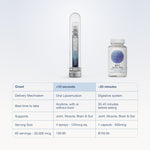
When people search for NMN vs. NAD+, they usually want a straightforward comparison. Here's how they compare as oral supplements:
|
Factor |
NAD+ |
NMN |
|
What it is |
A supplement form of the coenzyme your cells use for energy and metabolism |
A supplement form of a direct NAD+ precursor |
|
Molecular size |
Larger molecule (~663 g/mol) |
Smaller molecule (~334 g/mol) |
|
Oral bioavailability |
Larger size makes oral absorption challenging |
May be absorbed quickly and converted efficiently |
|
How it's typically used |
Often discussed in IV or specialty settings |
Widely available as oral capsules, powders, and sublingual products |
|
Steps to usable NAD+ |
Must be broken down then rebuilt inside cells |
One enzymatic step to convert to NAD+ |
The biggest distinction comes down to how well each one is absorbed.
NAD+
-
Larger molecule, harder to absorb orally
-
Must be broken down and rebuilt inside your cells
-
More commonly used in IV or specialty settings
NMN
-
Roughly half the molecular weight
-
May be absorbed through the small intestine and converted to NAD+ in a single step
-
Widely available as oral capsules, powders, and sublingual formats
Both ultimately serve the same goal: supporting healthy NAD+ levels. The difference is how each is processed and used in the body.
How NMN converts to NAD+ in the body
Your body doesn't just passively absorb NMN; it has a built-in system for putting it to use. The process happens through what's called the NAD+ salvage pathway, which is the primary way your cells maintain their NAD+ supply.
Here's the basic sequence:
-
Ingestion: NMN is taken orally and enters the small intestine.
-
Absorption: It passes into the bloodstream via blood plasma.
-
Cellular uptake: Cells across different tissues take up NMN.
-
Conversion: The enzyme NMNAT converts NMN directly into NAD+ in a single step.
That last point matters. NMN enters the salvage pathway as a near-ready building block, which means minimal processing and direct conversion.
The Slc12a8 transporter discovery adds another layer to this. Preliminary data suggests the body may have a dedicated mechanism for absorbing NMN directly from the gut before it's converted into NAD+. It's also worth noting that the salvage pathway, the one NMN feeds into, accounts for the vast majority of NAD+ production in adult cells, making NMN one of the most direct ways to support that system.
For a deeper jump into the science, you can explore this NAD+ biosynthesis research on PubMed Central.
Potential wellness benefits of supporting NAD+ levels
Supporting your body's NAD+ levels through NMN supplementation is eventually about giving your cells what they need to function at their best. Maintaining healthy NAD+ levels may help promote:
-
Cellular energy and everyday wellness
-
Healthy aging and long-term wellness
-
Focus and mental clarity
-
Everyday movement and active living
Cellular energy and everyday vitality
NAD+ plays a central role in converting nutrients into cellular energy through ATP production. When your cells have the NAD+ they need, energy metabolism runs more smoothly, and that can translate into the everyday energy you associate with feeling ready to take on your day.
Healthy aging and long-term wellness
NAD+ is deeply involved in sirtuin activation, and sirtuins are a group of proteins researchers are studying extensively in the context of longevity pathways and healthy aging. Since NAD levels may naturally decline over time, supporting those levels through supplementation is one way many people are choosing to invest in their long-term wellness.
For more on how longevity-focused strategies work together, check out our guide on senolytics and autophagy for longevity.
Focus and mental clarity
Your brain is one of the most energy-demanding organs in your body. NAD+ supports brain cell energy metabolism, which means maintaining healthy NAD+ levels may support focus and mental clarity throughout your day.
Preclinical research has explored connections between NAD+ and cognitive function, particularly its role in supporting the cellular energy demands of neurons. Human clinical research is ongoing.
Everyday movement and active living
NAD+ also supports muscle cell energy production, particularly in skeletal muscle. For people who value staying active, whether that means daily walks, weekend hikes, or simply keeping up with a busy schedule, supporting mitochondrial function and cellular energy at the muscle level can make a meaningful difference.
Natural ways to support healthy NAD+ levels
NMN supplementation can be a useful tool, but it works best as part of a broader wellness approach. Here are a few lifestyle factors that naturally complement your body's NAD+ production:
-
Diet: Foods rich in vitamin B3 serve as NAD+ precursors. Think whole grains, fish, mushrooms, and green vegetables. While the NMN content in foods like broccoli and avocado is minimal, a nutrient-dense diet supports overall cellular health.
-
Regular physical activity: Exercise has been shown to support NAD+ levels and mitochondrial health. Even moderate, consistent movement can make a difference.
-
Quality sleep: Your body's natural cellular processes, many of which depend on NAD+, are most active during deep sleep. Prioritizing rest supports cellular function across the board.
-
Stress management: Chronic stress places extra demands on your cells. Practices like mindfulness, time outdoors, and intentional downtime can help maintain your body's overall well-being.
Your cells are always working. Now you can work with them
NAD+ is the molecule your cells have always depended on for energy, cellular function, and everything in between. NMN provides a direct precursor your body can use to support NAD+ production as you age.
The science is still evolving, but the underlying biology is well studied: support your NAD+ levels, support your cells. Pair NMN supplementation with the habits that matter—movement, sleep, nutrition, and stress management—to take a more proactive approach to long-term wellness.
If you're ready to take the next step in NAD supplementation, InfiniWell's NMN is formulated to rigorous standards of quality and purity. As always, speak with a qualified healthcare professional before adding any new supplement to your routine.
NMN vs. NAD+: FAQs
-
SOURCES
You May Also Like
View All Articles

The Best Way to Take NMN: With or Without Food?
Wondering about the best way to take NMN? Learn what research says about daily amounts, taking NMN with or without food, timing, and choosing a quality supplement.

What Is KPV?
What is KPV, and why is it gaining attention in peptide research? Learn how this three-amino-acid peptide works, how it compares to BPC, and what current research suggests about its role in everyday wellness.