








































































Key takeaways
-
Mitochondrial health supplements include NMN, a NAD+ precursor, alongside ingredients such as urolithin A, CoQ10, magnesium, B vitamins, alpha-lipoic acid, and acetyl-L-carnitine. Their roles and the evidence behind supplementation vary.
-
Human trials, which are generally small and relatively short, have studied NMN for its ability to support NAD+ levels. NAD+ is a molecule involved in cellular energy metabolism.
-
Urolithin A is being studied for mitochondrial quality control, including mitophagy, the process cells use to recycle mitochondria. Human research has also examined its effects on mitochondrial biomarkers and muscle-related outcomes.
-
Senolytics and epicatechin are also being studied for their roles in cellular health. Research on senolytics has focused largely on cellular aging, while research specifically connecting epicatechin to mitochondrial function is still developing.
-
Nutrition and exercise remain the foundation of mitochondrial health. Supplements can complement these habits, and they're not a substitute for regular physical activity, adequate nutrition, sleep, and other health behaviors.
Most cells in your body contain hundreds to thousands of mitochondria. These structures turn nutrients from food into adenosine triphosphate (ATP), the main form of energy cells use to function.
Ingredients in mitochondrial health supplements are studied for their roles in different cellular pathways. Some are evaluated for cellular energy production, while others are linked to NAD+ metabolism, mitochondrial quality control, or healthy aging. The strength of the human evidence also varies by ingredient.
This guide looks at popular options, what they're studied for, and what the research tells us so far.
What mitochondria do
Mitochondria turn nutrients from food into ATP, which supplies energy for cellular activity. First, carbohydrates and fats are broken down through a series of reactions that release electrons. Those electrons then move through the electron transport chain inside the mitochondria, helping produce ATP. This final stage of energy production is called oxidative phosphorylation.
Energy production also generates reactive oxygen species (ROS). At normal levels, ROS are involved in cell signaling, and the body has antioxidant systems that regulate them. When ROS production exceeds these defenses, oxidative stress can occur and affect mitochondrial function.
Changes in mitochondrial function are among the biological processes researchers study as part of the hallmarks of aging.
Can supplements support mitochondrial health?
Some supplements may support processes related to mitochondrial health, but the evidence varies by ingredient. When looking at the research, it helps to distinguish between two types of evidence:
-
Mechanistic evidence: A compound affects a mitochondrial pathway in laboratory or animal studies. This can help researchers understand how an ingredient might work, but it doesn't necessarily show the same effect in people.
-
Human evidence: A compound has been tested in people, with researchers measuring outcomes such as biomarkers, muscle function, or changes in gene expression.
Human research on these supplements is still developing. Clinical trials have examined several compounds and their effects on specific biomarkers and measures of cellular function, but these findings don't establish an effect on lifespan.
Supplements also don't replace the fundamentals of mitochondrial health, which include regular physical activity, adequate sleep, and a nutritious diet.
Mitochondrial health supplements and ingredients
The ingredients below are grouped by the areas of cellular and mitochondrial health they're commonly studied for, from NAD+ metabolism and mitochondrial quality control to healthy aging and foundational nutrition.
NAD+ and cellular energy
Nicotinamide adenine dinucleotide (NAD+) is a coenzyme that helps cells produce energy. NAD+ levels may also change with age, although research suggests the pattern isn't necessarily consistent across all tissues.
Nicotinamide mononucleotide (NMN) is a precursor the body can use to make NAD+. Human trials have found that NMN supplementation can raise blood NAD+, while research in older adults has also explored outcomes such as walking speed and grip strength. These studies have generally been relatively small and short, so longer-term research is still needed.
InfiniWell's NMN supplement provides 200 mg of nicotinamide mononucleotide per two-capsule serving, paired with resveratrol and pterostilbene. Our beginner's guide to NMN covers the basics.
Mitochondrial quality control
Cells have systems for removing mitochondria that are no longer functioning properly. One of these is mitophagy, a selective recycling process that helps maintain the mitochondrial population.
Urolithin A is a compound produced by gut bacteria from substances found in foods such as pomegranates and berries. It has been studied for its role in mitophagy and mitochondrial function, as well as potential effects on muscle function.
Human research is still developing, and findings have varied depending on the outcome measured.
InfiniWell's Cellular Energy Pro contains urolithin A and is formulated to support cellular energy and mitochondrial health. You can also view the product's third-party testing.
Cellular aging
As we age, some cells stop dividing but remain in the body. Known as senescent cells, they can accumulate in tissues over time. Senolytic compounds are being studied for their potential role in cellular aging, an area that intersects with broader research on mitochondrial health.
Fisetin, a flavonoid found naturally in foods such as strawberries, is one compound being investigated for its senolytic properties. Much of the evidence comes from preclinical fisetin research, while research in people is still ongoing.
InfiniWell's Senolytic pairs 100 mg of fisetin with 400 mg of quercetin, plus resveratrol, pterostilbene, and curcumin. Our senolytics and autophagy guide goes deeper.
Muscle and metabolic support
Epicatechin is a flavanol naturally present in cocoa and other plant foods. Animal and small human studies have explored its relationship with skeletal muscle and mitochondrial function, including changes in mitochondrial biogenesis markers and muscle strength. The findings are preliminary, and larger controlled trials are needed.
InfiniWell's Epicatechin provides 500 mg per two-capsule serving and is formulated to support muscle function and nitric oxide production.
Foundational nutrients
Several everyday nutrients have established roles in cellular energy production. That doesn't mean taking more will provide additional mitochondrial benefits, especially when dietary intake is already adequate.
|
Nutrient |
Role in energy production |
Supplement considerations |
|
CoQ10 |
Carries electrons in the inner mitochondrial membrane and is required for ATP synthesis. |
CoQ10 levels may decline with age. Research has explored whether supplementation can help support CoQ10 levels and related functions, with mixed results. |
|
Magnesium |
Supports hundreds of enzyme systems, including those involved in energy production. |
Adequate intake is important, and some people don't get enough magnesium through their diet. |
|
B vitamins |
Several B vitamins act as cofactors in energy metabolism. Niacin supports NAD+, while riboflavin helps form flavin adenine dinucleotide (FAD) and flavin mononucleotide (FMN), two coenzymes involved in cellular energy production. |
Their roles in energy metabolism are well-established, but supplementation isn't necessarily beneficial when intake is already adequate. |
|
Alpha-lipoic acid |
Acts as a cofactor for mitochondrial enzyme complexes involved in energy metabolism. |
Alpha-lipoic acid serves as a potent antioxidant, but evidence for added mitochondrial benefit from supplementation is still limited. |
|
Acetyl-L-carnitine |
Carnitine helps transport fatty acids into mitochondria, where they can be used for energy. |
The body can produce carnitine, and supplementation has primarily been studied in specific populations and circumstances. |
These nutrients support processes involved in cellular energy, but individual supplement needs can depend on diet, age, health status, and other factors.
If you're looking to supplement B vitamins specifically, InfiniWell's Methylated B-Complex provides all eight B vitamins, along with choline and inositol.
How to choose a mitochondrial support supplement
When comparing mitochondrial health supplements, look beyond the ingredient list and consider the evidence, formulation, and product testing.
-
Look at the human evidence: Check whether the main ingredients have been studied in people or primarily in laboratory and animal research. Claims should reflect how established, or how preliminary, the research is.
-
Check the form and amount: Look for a label that clearly lists the form and amount of each active ingredient per serving. You can also compare the formulation with what has been evaluated in human research.
-
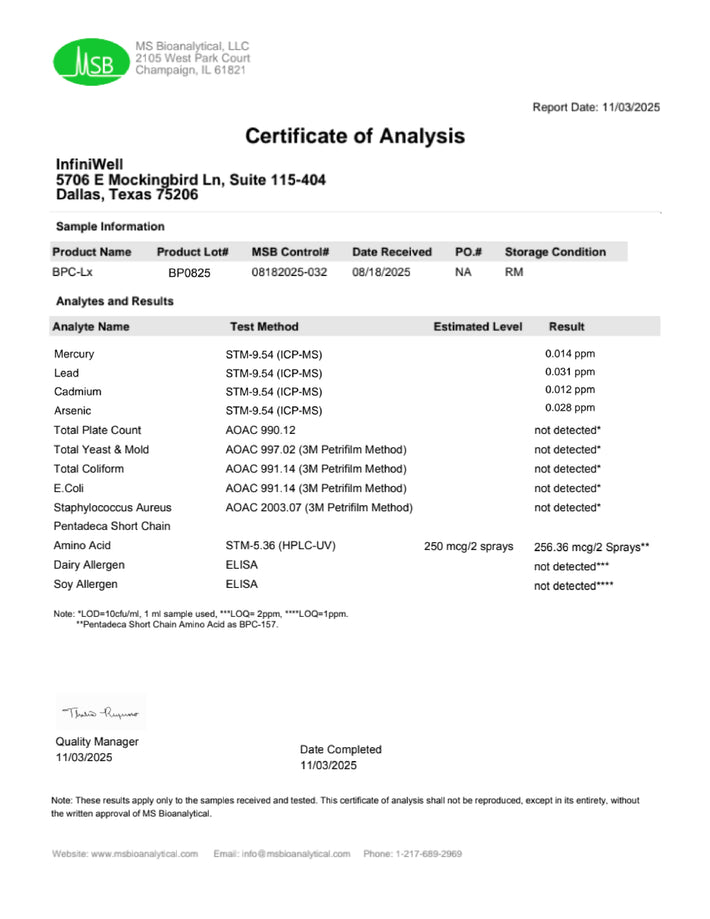
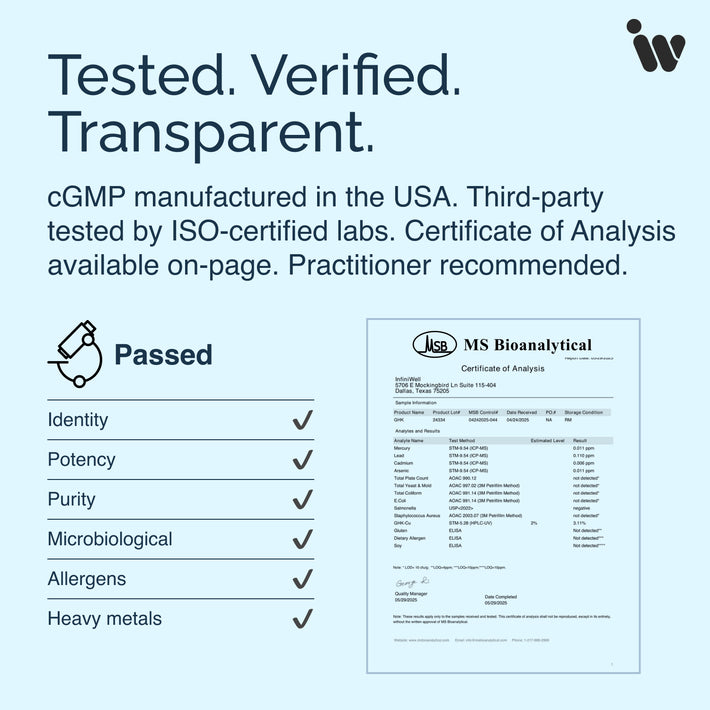
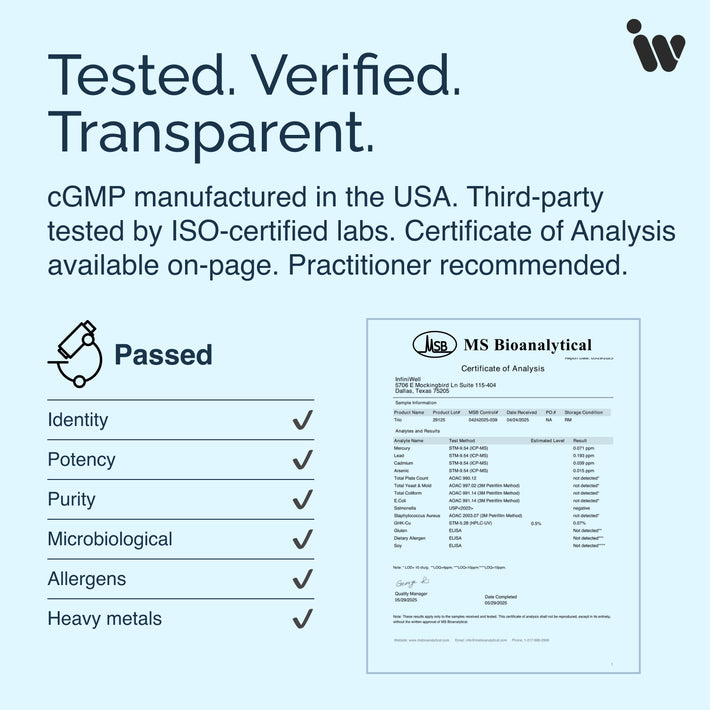
Look for third-party testing: A current Certificate of Analysis can provide information about a product's identity, potency, purity, and other quality measures, depending on what the lab tested.
-
Choose ingredients that fit your goal: Some ingredients are studied primarily for cellular energy and NAD+ metabolism, while others are researched in areas such as mitochondrial quality control, cellular aging, or muscle function.
Supporting mitochondrial health beyond supplements
Mitochondrial health depends on more than any individual nutrient or compound. Regular physical activity, adequate sleep, and a nutritious diet provide the foundation, while some supplement ingredients may support related cellular processes, including cellular energy production, NAD+ metabolism, and healthy aging, although the evidence varies.
If you're considering mitochondrial health supplements, start with the area you want to support and look at the evidence behind each ingredient. InfiniWell's aging and longevity support collection includes formulas designed to support different aspects of cellular health and healthy aging.
Mitochondrial health supplements: FAQs
-
SOURCES
Products mentioned in this article


You May Also Like
View All Articles

Best Supplements for Menopause Brain Fog: Comparing Popular Options
Key takeaways There's no single list of the best supplements for menopause brain fog. B vitamins, vitamin D, magnesium, and omega-3s support normal brain f...
Best Supplements for Menopause Brain Fog: Comparing Popular Options
Key takeaways There's no single list of the best supplements for menopause brain fog. B vitamins, vitamin D, magnesium, and omega-3s support normal brain f...