








Key takeaways
-
Alpha-melanocyte-stimulating hormone (alpha-MSH) is a 13-amino-acid signaling peptide your body makes from a larger precursor called proopiomelanocortin (POMC).
-
KPV is the lysine-proline-valine sequence at α-MSH's tail end, so it's a fragment of the hormone, not the hormone itself.
-
Alpha-MSH works through melanocortin receptors, and different receptors do different things, so one name doesn't mean one effect.
-
Research on KPV is mostly early cell and animal work, which can't stand in for a human result.
-
InfiniWell's BPC + KPV lists KPV as an ingredient, which doesn't mean it contains α-MSH or reproduces the full hormone.
Alpha-MSH is a small hormone your body makes on its own, and a lot of people land here after reading about KPV, which turns up in InfiniWell's BPC + KPV formula. The two names get used almost interchangeably online, which causes a fair amount of confusion. They're related, but they're not the same molecule, and that difference counts once you start reading research or product pages.
This guide is written for curious, healthy adults, and many readers arrive here from KPV research. It covers what alpha-MSH is, where it comes from, what it does in the body, and how the KPV peptide fits alongside it.
What is alpha-MSH?
Alpha-MSH, short for alpha-melanocyte-stimulating hormone, is a signaling peptide built from 13 amino acids. Chemists call a 13-amino-acid peptide a tridecapeptide, and it carries a positive charge, which makes it a cationic peptide. That length and charge are part of what define it. It belongs to a family of signaling molecules your body uses to pass messages between cells.
You'll also see it written as alpha melanocyte stimulating hormone, α-MSH, α-melanocyte stimulating hormone, or just MSH when the discussion covers the broader melanocyte-stimulating hormone group. The alpha version is the one most people mean when they talk about KPV, since KPV comes from it.
The full amino acid sequence ends in lysine, proline, and valine, and those final three are the KPV piece people ask about. We'll come back to that relationship in detail, because it's the source of most of the mix-ups.
Other names and basic details
A few quick facts help place α-MSH before we get into what it does. These are the details reference pages list first.
-
Other names: Alpha-melanocyte-stimulating hormone, α-MSH, alpha-melanotropin, and melanocyte-stimulating hormone (the broader group).
-
Type: A neuropeptide, meaning a small protein-like molecule that carries signals in the nervous system and beyond.
-
Length and molecular weight: Thirteen amino acids, which puts its molecular weight in the small-peptide range, far lighter than a full-size protein.
-
Family: Part of the melanocortin system, alongside adrenocorticotropic hormone and the other melanocyte-stimulating hormones.
Where does alpha-MSH come from?
Alpha-MSH isn't made directly. Your body builds a larger precursor protein first, called POMC, then trims it down into smaller active pieces.
According to the NCBI gene record for POMC, the precursor is cut by enzymes into smaller molecules, and the cutting depends on the tissue. Different tissues use different cleavage sites, so the same starting protein can yield different products in the pituitary than it does in the brain or skin. Adrenocorticotropic hormone (ACTH) is one well-known product, and the melanocyte-stimulating hormones, including α-MSH, come from the same precursor.
The Society for Endocrinology's hormone page describes MSH as a group of hormones produced in the skin, the pituitary gland, and the hypothalamus, all from that shared POMC precursor. In the pituitary, the same precursor also yields adrenocorticotropic hormone, which shows how one starting molecule can lead to very different signals depending on where processing happens. A shared starting point doesn't mean every tissue produces or uses the same fragments in the same way, which is a theme worth keeping in mind.
What triggers alpha-MSH production?
Production comes down to where POMC gets processed and what's prompting it, and a review of α-MSH production walks through those steps. In the skin, ultraviolet light is a well-studied trigger: UV exposure increases α-MSH, which then signals the pigment-making cells. In the brain, POMC processing in the pituitary and hypothalamus feeds into the body's own signaling, no outside prompt required.
This is background biology, not a how-to. The point is where alpha-MSH comes from, not a set of tips for changing your own levels.
What does alpha-MSH do?
α-MSH is a signaling molecule, which means it interacts with systems in the body that are set up to respond to it. The response depends on the molecule, the receptor it meets, the tissue it's in, and the surrounding context. A name alone doesn't determine what happens.
Alpha-MSH belongs to the melanocortin system, and scientists study that system in connection with pigmentation, energy balance, and immune signaling. Those are descriptions of the body's own biology, not claims about taking a peptide product. Here are the three roles that come up most:
-
Skin pigmentation: α-MSH signals melanocytes, the pigment cells in your skin, to drive melanin production, the melanin synthesis that gives skin and hair their color and absorbs UV light. This role in skin pigmentation is the one the hormone is named for, and its activation of pigment cells is among the best-studied parts of melanocortin development.
-
Energy balance: In the hypothalamus, part of the central nervous system, α-MSH is one of the signals the brain uses for energy balance, energy homeostasis, and metabolism, a pathway sometimes described alongside energy expenditure.
-
Immune signaling: α-MSH also takes part in immune signaling and immune responses in the brain and peripheral organs, working through a cell messenger called cyclic adenosine monophosphate (cAMP), which links it loosely to the broader immune system.
In energy-balance signaling, α-MSH works opposite agouti-related protein, another melanocortin-system signal, so the two act as a push-and-pull pair. The regulation here is primarily about signaling pathways, and the targets are receptors on specific cells.
Understanding these pathways helps explain why researchers find the molecule interesting. It doesn't establish that a different fragment, a different formulation, or a different route of delivery produces the same effects.
Most of what's known comes from research in cells and animals, and some from studies in humans. These are generally descriptions of how the hormone's own production and regulation work, not claims tied to a supplement. The same distinction runs through the melanocyte-stimulating hormone literature overall, where background biology and product claims are easy to blur.
How the melanocortin receptors differ
α-MSH does its signaling by binding to melanocortin receptors, and there are five recognized subtypes, usually written MC1R through MC5R. Molecules that switch these receptors on are called agonists, and ones that block them are antagonists. The subtypes sit in different tissues and respond to different things, so grouping them under one label hides a lot of variation.
One distinction matters more than the rest: α-MSH acts at MC1R, MC3R, MC4R, and MC5R, but not at MC2R. MC2R is the receptor for ACTH, not α-MSH, so listing it as an alpha-MSH receptor would be wrong. The table below lays out the general picture.
|
Receptor |
General context |
Reading caution |
|
MC1R |
Pigment-cell signaling in skin and hair |
Background biology, not a product claim |
|
MC2R |
ACTH-responsive signaling |
Don't list it as an α-MSH receptor |
|
MC3R and MC4R |
Central signaling tied to energy balance |
Don't infer a body-composition result from KPV |
|
MC5R |
Signaling in several peripheral tissues |
Receptor membership doesn't mean identical effects |
This overview is deliberately limited. A receptor map isn't a guide to changing your own hormonal signaling, and it doesn't settle which receptors a short fragment like KPV engages under any given conditions. Different melanocortin receptors produce different physiological effects, and that variety is the reason you can't read one effect off the hormone's name.
How is KPV related to alpha-MSH?
K, P, and V are the single-letter codes for the amino acids lysine, proline, and valine, sometimes written out as Lys-Pro-Val. Put them together and you get a tripeptide, a three-amino-acid chain. In α-MSH, that exact sequence sits at the C-terminal end, meaning the tail end of the peptide chain.
So the relationship is real and specific: KPV is literally the last three amino acids of alpha-MSH. That's a chemical fact. Whether the fragment behaves like the whole hormone is a separate question that needs its own evidence, because removing most of a molecule can change its shape, how it interacts with receptors, how stable it is, and more.
Lab studies trace much of α-MSH's immune signaling activity to that KPV sequence, but that's early cell and animal research, not a human outcome and not a product claim. Our guide to the KPV peptide covers the fragment on its own terms. When you read a summary that uses both names, the useful habit is to keep the full hormone and the fragment separate.
The table below keeps the three molecules straight, plus the finished formula they get discussed alongside.
|
Term |
Identity |
What it does not imply |
|
POMC |
A larger precursor processed into several peptides |
That every fragment has identical activity |
|
α-MSH |
A 13-amino-acid signaling peptide |
That a KPV product contains the whole hormone |
|
KPV |
A three-amino-acid sequence |
That it reproduces all of alpha-MSH's actions |
|
BPC + KPV |
A finished combination formula |
That research on either ingredient alone validates the combination |
Alpha-MSH vs. KPV: What's the difference?
It helps to put the hormone and the fragment side by side, since the whole point is that they're not interchangeable. The table below compares them on the basics.
|
Feature |
α-MSH |
KPV |
|
Length |
13 amino acids |
3 amino acids |
|
Origin |
Cleaved from the POMC precursor |
The C-terminal end of alpha-MSH |
|
Where it sits |
A complete signaling hormone |
A fragment of that hormone |
|
What research looks at |
Pigmentation, energy balance, immune signaling |
Mostly early cell and animal work on immune signaling |
The short takeaway: α-MSH is the full hormone your body makes, and KPV is a small piece of it that researchers study separately. A shared sequence makes them related, not equivalent.
What can a fragment study establish?
A study is only as specific as the molecule it tests. A result for α-MSH can't be automatically assigned to KPV, and a result for KPV can't be automatically assigned to another peptide sitting in the same formula. The molecule tested is part of the finding.
The experimental model counts just as much. A cell experiment can explore an interaction in a dish, and an animal experiment can examine biology in that animal, but neither is the same as a controlled study of a finished product in people. Reading a mouse result as a human outcome skips several steps that the research itself didn't take.
This is why careful explainers keep the evidence level attached to every claim. A mechanism can be genuinely interesting and still leave the product question open.
Does sequence similarity establish delivery?
No. Identity, stability, uptake, exposure, and final outcome are all different questions. A short peptide's relationship to a hormone doesn't establish that an oral formula reaches a particular place in the body in a particular form.
Our guide to how oral peptides are absorbed walks through why delivery evidence has to match the actual molecule and formulation. A finding from a different route or a different preparation isn't a set of instructions for a consumer product, and a formulation ingredient on its own isn't proof of an effect. The complete preparation and the specific claim have to be evaluated together.
Where does BPC + KPV fit in?
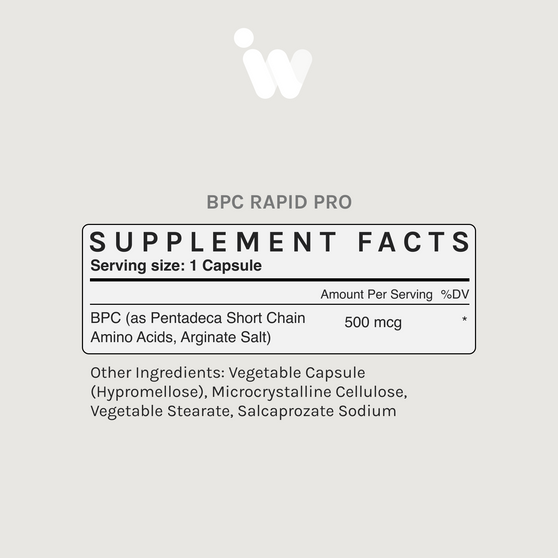
InfiniWell's BPC + KPV is an oral capsule that combines BPC, listed as Pentadeca Short Chain Aminos, with KPV, listed as Tri Short Chain Amino Acids. It doesn't list the complete alpha-MSH hormone as an ingredient, and nothing about including KPV means the hormone is present or that its actions are reproduced.
It's a formula that promotes healthy cellular signaling and supports gastrointestinal barrier function. That label description is the scope of the product discussion here. No pigmentation, energy-balance, or hormone-equivalence outcome follows from the presence of KPV, and the basics of this ingredient class are covered in our overview of bioactive peptides.
As with any supplement, the sensible steps are to review the complete label and talk to a qualified healthcare professional before adding it. If the directions need clarification, ask the manufacturer rather than borrowing a routine from a study or a related molecule.
How to read a peptide explanation
Peptide content online ranges from careful to misleading, and a few habits help you tell them apart. Use these as a quick filter whenever an article moves between a hormone and one of its fragments.
-
Start with the exact molecule: Does the article keep discussing that molecule, or does it drift to a related fragment without flagging the switch? A shared sequence can be relevant without making two compounds interchangeable.
-
Check the evidence level and route: A mechanistic illustration can be accurate and still leave the product question unanswered. Ask whether the cited study tested the same preparation in a relevant setting, and whether the subjects were cells, animals, or people.
-
Separate quality from effectiveness: A certificate of analysis documents what's in a sample, which is about quality, not proof that a formula reproduces a parent hormone's biology. Our guide to reading a certificate of analysis explains what those documents do and don't tell you.
Run an article through those three checks and most of the hormone-versus-fragment confusion sorts itself out.
Keep the molecular distinctions clear
Alpha-MSH is a 13-amino-acid hormone your body makes from the POMC precursor, it works through melanocortin receptors, and it takes part in pigmentation, energy balance, and immune signaling. KPV is the three-amino-acid tail of that hormone, studied mostly in early cell and animal work, and a fragment doesn't automatically carry the whole molecule's properties.
For the product side, treat InfiniWell's BPC + KPV formula as its own finished capsule with its own label and its own evidence requirements, separate from the biology of the parent hormone. Review the label, keep the hormone and the fragment straight, and talk to a qualified healthcare professional before starting anything new.
Alpha-MSH: FAQs
-
SOURCES
Products mentioned in this article

You May Also Like
View All Articles

Do Oral Peptides Work? What the Research Shows
Some oral peptides can be absorbed and many cannot, and the honest answer depends on the exact molecule and how the product is made. This guide walks healthy adults through what happens after you swallow a peptide, what the research actually shows, and how to read an oral peptide label before you buy.

Probiotics After Antibiotics: How to Support Your Gut Health
Probiotics after antibiotics are worth thinking about, but the evidence is more specific than most headlines suggest. Here's a look at what research shows, the foods that support a healthy gut, and how to read a probiotic label before you buy.