









































Key takeaways
-
NMN is a precursor your body can use to make NAD+, a coenzyme involved in cellular energy production and normal mitochondrial function.
-
TMG, also known as betaine anhydrous, is a methyl donor that provides methyl groups, which are small chemical units used in many normal processes throughout the body.
-
Some nicotinamide produced during NAD+ metabolism is processed for elimination, and this process uses methyl groups. This has led to the theory that higher NAD+ precursor intake could raise methyl demand, which is where TMG may come in.
-
Human research on NMN supplementation is still developing. There isn't strong evidence showing that taking NMN depletes methyl groups or that everyone taking NMN needs TMG. For now, the pairing is better viewed as a supplemental strategy than a proven requirement.
-
NMN and TMG have each been studied in humans, but research on taking them together is limited. Talk with a qualified healthcare professional before adding either supplement to your wellness routine.
You added NMN to your routine, felt good about it, then read a forum thread saying you're doing it wrong without TMG. Now you're looking at a bottle of TMG and wondering whether you really need to add it or if it's just a clever upsell.
Fair question. Search "NMN and TMG" and you get plenty of strong opinions and very little plain explanation, so let's clear up why these two supplements are often paired.
Start with what NMN is for. Your cells rely on a coenzyme called NAD+ to help turn nutrients from food into usable energy. Your body is thrifty about making it. Roughly 85% of NAD+ production comes from recycling components already in circulation rather than starting from scratch. That recycling process is called the salvage pathway, and NMN is one of the building blocks used to make NAD+.
So where does TMG fit into all of this? It comes down to methylation, a process we'll unpack below.
What NMN does inside your cells
NMN is short for beta-nicotinamide mononucleotide. It sits one step away from NAD+ in the salvage pathway, which is why it gets so much attention in the healthy aging space.
NAD+ isn't some obscure molecule because it plays a fundamental role in normal cellular function. Your cells use it constantly, and it shows up in three key areas:
-
Cellular energy production: NAD+ helps your cells turn nutrients into adenosine triphosphate (ATP), the main form of energy cells use. It also plays an important role in mitochondrial function and cellular metabolism.
-
Sirtuin activity: Sirtuins are a family of enzymes that depend on NAD+ to function and are involved in several processes that help maintain normal cellular function.
-
DNA maintenance: PARP enzymes use NAD+ to support normal processes involved in maintaining DNA integrity.
NAD+ levels are not fixed. One small cross-sectional study of human skin tissue found that lower NAD+ levels were associated with older age. The study was limited to one type of tissue and a relatively small group, so it doesn't establish that NAD+ declines uniformly throughout the body with age. Still, findings like these have contributed to interest in NAD+ precursors such as NMN.
If you want the longer version, our guide on how NMN works walks through the pathway step by step, while NMN and NAD+ explains how the two relate.
What does human research on NMN show?
Human research on NMN is encouraging, with the important caveat that it's still developing. In a 60-day placebo-controlled trial of 80 healthy middle-aged adults, participants taking NMN had higher blood NAD+ concentrations than the placebo group. A separate 12-week trial in older adults also reported higher blood NAD+ and related metabolites.
These studies were relatively small and short, so the findings should be interpreted cautiously. Research is ongoing and not definitive.
What TMG is and what a methyl donor does
TMG stands for trimethylglycine. On a supplement label, it often appears as betaine anhydrous. Structurally, it's a derivative of the amino acid glycine with three methyl groups attached, and those methyl groups are what give TMG its role as a methyl donor.
A methyl group is a small cluster of carbon and hydrogen atoms that can be transferred from one molecule to another. That process, called methylation, is involved in many normal processes throughout the body, including gene activity and the production of certain compounds.
TMG contributes methyl groups to the process. In the liver and kidneys, betaine donates a methyl group in a reaction that re-forms methionine. Methionine can then be used to make S-adenosylmethionine (SAM), one of the body's primary methyl donors. Think of SAM as a delivery truck carrying methyl groups for use in many different reactions.
You also get betaine from food. Beets, wheat germ, spinach, and quinoa are among the dietary sources. In fact, betaine gets its name from the sugar beet, Beta vulgaris.
A quick recap before we connect the dots
We've covered several terms already. Here are the key ones to keep in mind:
-
NMN: A building block your body can use to make NAD+.
-
NAD+: A coenzyme your cells use for energy production and other normal cellular processes.
-
Nicotinamide: A form of vitamin B3 produced when NAD+ is used. Much of it can be recycled to make NAD+ again.
-
Methyl group: A small chemical unit that can be transferred between molecules.
-
Methylation: The process of transferring a methyl group from one molecule to another.
-
TMG: A methyl donor, meaning it helps supply methyl groups used by the body.
-
SAM: One of the body's main methyl donors. Each SAM molecule carries one methyl group and transfers it to another molecule that needs it.
The methylation link between the two
Now the connection everyone's asking about.
When your cells use NAD+, they produce nicotinamide as a byproduct. The body can recycle much of it to make more NAD+, but some nicotinamide is processed for elimination instead. That process uses a methyl group supplied by SAM.
And this is where the NMN-TMG connection comes in. If NMN leads to greater NAD+ production and turnover, more nicotinamide could potentially need to be processed, which may place additional demand on the body's methyl supply. TMG may help support that supply.
The mechanism is plausible, but the human evidence is limited. Research has not established that taking NMN causes meaningful methyl depletion or that TMG is necessary alongside it. For now, pairing the two is better understood as a supplemental strategy based on biochemical reasoning, not a proven requirement.
NMN and TMG at a glance
We've covered the chemistry. Here's how NMN and TMG compare side by side and where each fits into the proposed pairing.
|
NMN |
TMG (betaine anhydrous) |
|
|
What it is |
A direct precursor to NAD+ |
A methyl donor derived from glycine |
|
Main role |
Provides a building block used to make NAD+ |
Supplies methyl groups used in methylation |
|
Found in food |
Trace amounts in foods such as avocado, broccoli, and edamame |
Found in foods such as beets, wheat germ, spinach, and quinoa |
|
Typical formats |
Capsules, powder, sublingual, and liposomal formulas |
Capsules and powder |
|
Role in the pairing |
Supports NAD+ production |
May help support methyl availability if NMN creates additional methyl demand |
How people usually take them
There is no single established routine for taking NMN and TMG together. How and when you take them can depend on the specific formulas and their suggested use.
NMN is commonly taken earlier in the day, partly because researchers have explored the relationship between NAD+ metabolism and circadian rhythms. However, human research has not established an ideal time for NMN supplementation. People who pair NMN with TMG may take them at the same time simply for convenience, but there is no established requirement that the two be taken together.
Format is another consideration. NMN is available in capsules, powders, sublingual products, and liposomal formulas, while TMG commonly comes in capsules or powder. Different delivery methods are often marketed around absorption, but direct human comparisons remain limited.
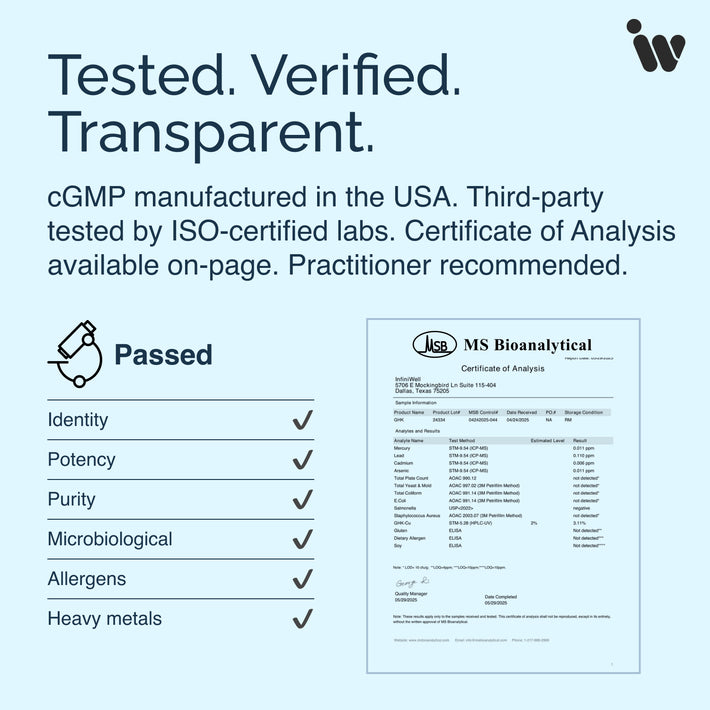
Whatever format you choose, follow the product's suggested use and look for transparent labeling and independent quality testing. A Certificate of Analysis can provide additional information about a supplement's identity and testing.
A few things to keep in mind:
-
Follow the suggested use: Stick with the directions provided on the product label.
-
Keep the basics in place: Quality sleep, regular physical activity, and a nutrient-rich diet remain the foundation of a healthy aging routine.
-
Individual experiences vary: How someone responds to a supplement can differ from person to person.
If you're building a routine around this category, InfiniWell offers an NMN supplement as well as Enhance, a TMG and spermidine formula. You can also explore the full longevity support collection.
The bottom line on NMN and TMG
Talk with a qualified healthcare professional before adding NMN, TMG, or any new supplement to your routine, particularly if you're pregnant or nursing or already follow a supplement or wellness regimen. They can review your overall routine, since methyl donors can appear in multiple formulas and may be easy to overlook.
NMN and TMG: FAQs
-
SOURCES
Products mentioned in this article


You May Also Like
View All Articles

Best Supplements for Menopause Brain Fog: Comparing Popular Options
Key takeaways There's no single list of the best supplements for menopause brain fog. B vitamins, vitamin D, magnesium, and omega-3s support normal brain f...
Best Supplements for Menopause Brain Fog: Comparing Popular Options
Key takeaways There's no single list of the best supplements for menopause brain fog. B vitamins, vitamin D, magnesium, and omega-3s support normal brain f...