



























































Key takeaways
-
CoQ10 participates in the mitochondrial electron transport chain, which helps produce ATP.
-
The body makes its own CoQ10, and research shows those levels tend to fall with age.
-
CoQ10 is concentrated in high-energy tissues such as the heart, liver, kidneys, and pancreas, and it is fat-soluble.
-
Ubiquinone and ubiquinol are different forms of the same coenzyme, and the body interconverts them.
-
Antioxidant activity does not establish a noticeable energy result from a supplement.
-
A useful product comparison includes the full label, quality documentation, and the clinical evidence for the specific claim.
Coenzyme Q10 (CoQ10) benefits start with its normal role in the body: helping move electrons during cellular energy production and participating in antioxidant chemistry.
This guide is written for healthy adults who are comparing a CoQ10 dietary supplement, and those established functions are different from a promise that a supplement will make everyone feel more energetic.
If you are comparing products, InfiniWell CoQ10 uses a MicroActive CoQ10 ingredient approach. Start with the current label, then separate the science of the molecule from evidence about the finished formula.
What is CoQ10?
Coenzyme Q10 is a fat-soluble compound the body makes. The name is often shortened to CoQ10. It is found in cell membranes and is part of the machinery that allows mitochondria to turn fuel-derived energy into a usable form.
Mitochondria are structures inside cells. Their inner membranes contain a series of electron-transfer steps, collectively called the electron transport chain. CoQ10 carries electrons within this system as part of normal mitochondrial function, and the process helps create the conditions used to make adenosine triphosphate, or ATP.
ATP powers many ordinary cellular activities. Describing CoQ10's involvement in energy production explains its physiological role; it does not show that adding more CoQ10 makes every cell produce more ATP. The amount present, the surrounding biology, and the outcome being measured are separate questions.
Where CoQ10 is stored and found in food
The body stores the highest amounts of CoQ10 in high-energy tissues such as the heart, liver, kidneys, and pancreas. Research shows the body's own CoQ10 levels tend to fall with age. CoQ10 also occurs in food.
Dietary sources of CoQ10 include organ meats and fatty fish, with smaller amounts in other foods, so a varied diet supplies some alongside the body's own production.
Ubiquinone vs. ubiquinol: What is the difference?
Ubiquinone is the oxidized form of CoQ10, while ubiquinol is the reduced form. Their interconversion is part of how CoQ10 carries electrons. A scientific overview of CoQ10 chemistry explains these forms and the body's own synthesis of the compound.
|
Term |
Meaning |
What to check on a label |
|
CoQ10 |
The broader coenzyme name |
Whether the product identifies a particular form |
|
Ubiquinone |
The oxidized form |
Ingredient identity and formulation |
|
Ubiquinol |
The reduced form |
Ingredient identity and formulation |
|
Delivery technology |
A method used to formulate the ingredient |
Evidence relevant to the specific formulation |
A formulation name is not necessarily the name of an oxidation state. Do not assign a product to ubiquinone or ubiquinol unless the manufacturer identifies it that way. The current InfiniWell CoQ10 page lists MicroActive CoQ10. That wording should not be silently expanded into a different ingredient claim.
What does antioxidant activity mean?
CoQ10 is a fat-soluble antioxidant, which describes a type of chemistry rather than a guaranteed benefit. A few distinctions help put that antioxidant activity in context:
-
Free radicals, sometimes described as harmful compounds, form during normal energy production, and CoQ10 helps cells handle this everyday oxidative stress.
-
Researchers describe this antioxidant protection as oxidation-and-reduction chemistry, not a universal score of how beneficial an ingredient will be as a supplement.
-
Laboratory measurements, blood concentrations, and changes people notice in daily life are different endpoints, so the antioxidant effects seen in a lab are not the same as a felt benefit.
-
Healthy-aging language deserves the same caution: a compound's normal biological role does not establish that taking it changes lifespan.
If an article jumps from antioxidant activity to a promise about how you will feel, look for the human study supporting that step.
Potential health benefits of coenzyme Q10: What the research shows
Research on coenzyme Q10 answers different questions depending on what was measured, so read any potential health benefits against the specific study. A few points help:
-
Much of the human research uses clinical trials, including randomized controlled trials, and a systematic review can pool those clinical studies.
-
One GRADE-assessed meta-analysis of randomized controlled trials reported that coenzyme Q10 supplementation lowered some blood markers of oxidative stress, such as malondialdehyde, compared with placebo, while rating the certainty of that evidence as very low.
-
Consistent with that caution, the National Center for Complementary and Integrative Health describes the evidence for many uses as limited or inconclusive, and many of these clinical studies enrolled people with specific health concerns, so the clinical evidence for healthy adults is more limited.
-
Where research suggests a direction, more research is often needed before there is conclusive evidence or a significant difference between groups, and there is not always enough evidence to confirm the potential benefits for everyone.
-
Because CoQ10 is fat-soluble, research suggests it is absorbed better with a meal that contains some fat, so follow the label's suggested use rather than the amount used in a study.
Before relying on a headline, look for the study preparation, participant group, comparison group, and outcome. Research on an ingredient also remains separate from research on an InfiniWell finished product.
CoQ10 vs. NMN: Different parts of the energy discussion
CoQ10 is involved in electron transport. NMN is a precursor the body uses to make NAD+, another coenzyme involved in metabolism. Urolithin A is discussed in mitochondrial-maintenance research. These are related topics, but the compounds are not interchangeable.
|
Ingredient |
General biological context |
Formula distinction |
|
CoQ10 |
Electron transport and antioxidant chemistry |
Listed in InfiniWell CoQ10 |
|
NMN |
Precursor for NAD+ synthesis |
Included in InfiniWell NMN and Cellular Energy Pro |
|
Urolithin A |
Mitochondrial-maintenance research |
Combined with liposomal NMN in Cellular Energy Pro |
Cellular Energy Pro contains liposomal NMN and urolithin A; it should not be described as a CoQ10 product. Our NR vs. NMN article explains the NAD+ precursor terminology in more detail.
There is no need to turn this comparison into a universal winner. Choose the question you want to discuss, identify the complete formula, and review how it fits with products you already use.
How to compare a CoQ10 supplement
A good comparison starts with the label and your overall health, not the loudest claim. When comparing CoQ10 supplements and other dietary supplements, work through a few checks:
-
Review the ingredient panel and suggested use: serving size, disclosed amount, other ingredients, storage information, and manufacturer contact details. Do not borrow another product's serving instructions just because the front labels both say CoQ10.
-
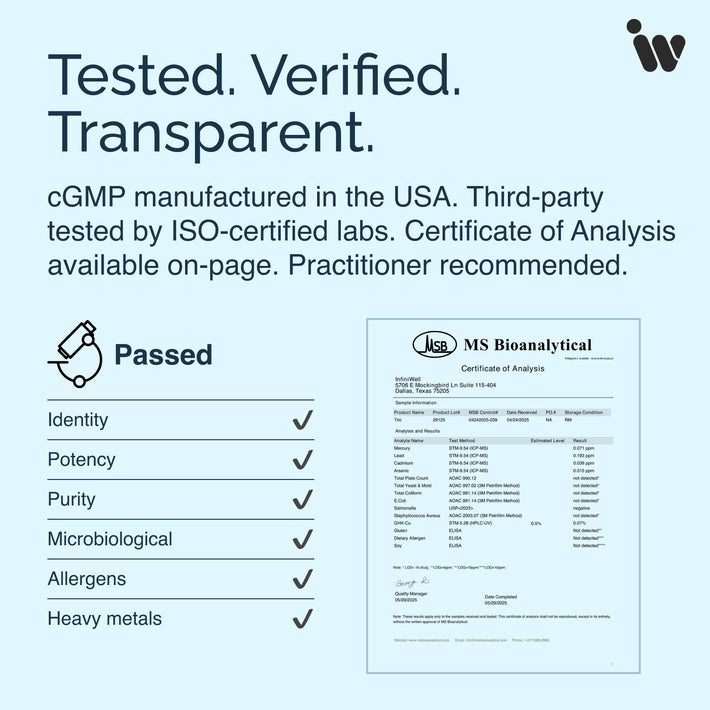
Look for quality documentation that identifies what was tested; a report about ingredient identity answers a different question from one about contaminants or quantity. Our CoA guide explains how to read it without mistaking it for evidence of effectiveness.
-
For a formulation or absorption claim, ask whether the research tested the same ingredient preparation and what it measured. A delivery-system name alone is not a quantified comparison, and this article does not apply absorption multipliers to InfiniWell CoQ10.
-
Consider how the product sits alongside other nutrients you take and your overall health. CoQ10 may interact with certain medications, so review it with a qualified healthcare professional or healthcare provider. CoQ10 also appears in some skin care products, though this article focuses on the capsule.
Our NMN buying guide offers additional label-reading questions that also apply when comparing multi-ingredient products.
Review the formula in context
Use InfiniWell CoQ10's current product information to review its ingredients and suggested use. Keep the distinction between normal cellular biology and demonstrated supplement outcomes clear as you decide what belongs in your routine.
CoQ10 benefits: Frequently asked questions
-
SOURCES
Products mentioned in this article


You May Also Like
View All Articles

Peptides for Hair Growth: A Guide to Cosmetic Scalp Care
Peptides for hair growth get discussed as if they all do the same thing, but the ingredients and the evidence differ. This guide compares GHK-Cu, zinc thymulin, and PTD-DBM as cosmetic scalp care, and explains what the research can and cannot show.

How Much Urolithin A per Day? Serving Amounts and Timing
How much urolithin A should you take each day? Learn how to read serving sizes, distinguish research amounts from personal recommendations, and check your product’s directions for timing and food.